Forestry Mulching
Home › Services › Forestry Mulching
Open up overgrown ground in a single pass and leave the property usable the day we finish.
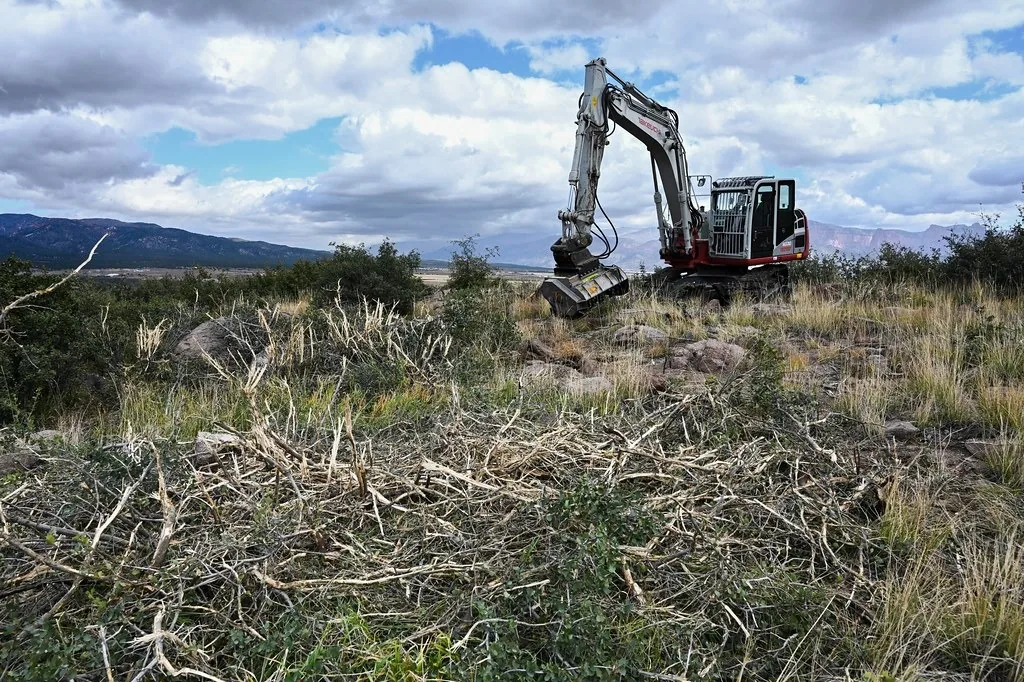
What mulching actually does
A mulching head is a drum of fixed teeth that grinds standing vegetation down where it is rooted and spreads the material back across the ground as a layer of chip and fiber. Brush, briars, saplings, vines, and smaller trees go through it in one pass. Nothing gets stacked, nothing gets burned, and nothing leaves the property on a trailer.
That difference matters more than it sounds. Conventional clearing means cutting, dragging, piling, and then dealing with the pile, which usually means a burn permit, time spent minding the fire, and bare ground where the pile sat. Mulching skips that step. When we pull off the job, the ground is walkable and the mulch layer is already doing something useful, holding soil in place on slopes and slowing the regrowth it is sitting on top of.
It also means we are not tearing up the ground to get the work done. The root systems stay where they are and the soil structure stays intact, which is the difference between land you can drive across afterward and land that turns to soup the first time it rains.
What it handles, and where it stops
Our day rate covers light vegetation and density, which in practice means trees roughly six inches in diameter and under. That is most overgrowth: fence rows that got away, pasture edges creeping in, understory brush, cedar, briars, and the young growth that fills in any Arkansas ground nobody has touched for a few years.
Heavier timber is a different conversation. Larger trees can still come out, but the machine, the pace, and the pricing all change, which is why we look at a property before we quote it. Density does the same thing. An acre of scattered saplings and an acre of solid thicket are the same acre on paper and nowhere near the same job in practice.
We can also be selective about it. Mulching does not have to mean taking everything. If you want the mature hardwoods left and only the understory cleaned out, or a specific corridor opened and the rest untouched, that is a normal way to run the job. Tell us what stays and what goes when we walk it.
Why people ask for it
Most of the calls we get come down to the same thing. Somebody owns ground they cannot use, reach, or see, and they want that to change.
That looks like pasture edges that have been closing in for years, building sites that need to be opened before anything else can start, trails and access routes into the back of a property, fence lines that have to be cleared before they can be rebuilt, and hunting ground where the understory has gotten too thick to move through or see into. Recreational and residential acreage, working land, and lots being prepped for construction all end up in the same place.
It also works well as a first step. Plenty of jobs start as mulching and turn into driveway work, a pad, or drainage once the ground is visible and the owner can actually see what they are dealing with. We would rather open it up and then talk about the rest than guess at a plan through a wall of brush.
Alongside mulching we also handle stump removal, land leveling and grading, pond digging and pond repair, and general dozer work.
FAQ
How much does forestry mulching cost?
Mulching is priced on a day rate with a daily minimum of $2,250, which covers light vegetation and density with trees roughly six inches and under. Heavier or denser growth changes the pace and the price, so we look at the property before quoting it.
How much ground can you cover in a day?
Roughly three-quarters of an acre to an acre a day in typical conditions. Density, tree size, terrain, and access all move that number in either direction, which is the main reason we walk a property before giving you a number.
What happens to the mulch left behind?
It stays on the ground as a layer of chip and fiber. It breaks down over time, helps hold soil on slopes, and slows regrowth underneath it. There is no pile to burn and nothing to haul away.
Tell us what you are looking at
Overgrown acreage, a driveway that keeps washing out, or ground that needs to be ready for something else. Send us the details and we will come look at it.
Get an Estimate